
Tips Tuesday – Update WP, Interest in WP Falling, Time for a Change
Tips this week include:
- Why you need to update PHP before you update WordPress
- Wordcamp U.S. thoughts
- Is interest in WP waning?
- My own trends in WP and other platforms test results and what they mean
- Is it time for a change with your blog?
- Why some bloggers keep doing what works – and should
- Why some need to move blogging to a side hustle
- Find a way to incorporate AI
This post contains affiliate links. Thank you for using them to support the free and helpful content you receive from BlogAid.
WordPress Tips
Update PHP Before WordPress
We are ready to do the WP 6.3 update, but you first need to update the PHP version at your host to 8.1.
Most of the issues that happened with WP 6.3 updates were fixed when running on PHP 8.1.
And we were going to need to update to that before the end of this year anyway.
I took my site audit clients through the bigger PHP jump of 7.6 to 8.0 back in November. Some folks had to change themes or plugins that were just to old to work with current coding languages.
But, it’s not as drastic going up to 8.1, so no breaks reported when I guided them through this update..
I sent BlogAid News subscribers my special update instructions for WP 6.3.
Tell Your Friends
If you’ve been helped by BlogAid and all of the testing I do and instructions I provide to keep you in the know and out of panic, please tell your friends where to go for their site needs.
Wordcamp US – The Future is Not About Bloggers
Wordcamp US was this past weekend.
I did not attend the virtual events live and I don’t plan to watch the replays.
Here’s why.
WordPress 6.3 marks the end of Gutenberg Phase 2. Phase 2 brought us the Gutenberg Editor. Phase 2 brought us Block Themes.
They will now begin work on Phase 3, which is making WP for teams and other such things that has little to no bearing on us bloggers.
That doesn’t mean we won’t continue to see Gutenberg improvements. We will.
But those are no longer the focus of WP.
One of the other things they will continue to focus on is performance. I agree with that mission in theory. But I have profound disagreements with the way the WP Performance team is approaching it. In fact, the exhaustive battle in trying to stop a detrimental inclusion is what broke my spirit of being part of it anymore. The pleadings of me and 300 other WP professionals went unheard for months and that project only got dropped from inclusion when Matt Mullenweg himself stepped in to say no.
The devs on that team have managed to run off everybody that disagrees with them and the new checks we are getting don’t really have anything to do with WordPress itself and should not be included in the Site Health Check. In fact, fully managed hosts are putting directives into core files so those things will not be seen by the end user.
In my mind, WordPress has totally lost its way. It was started to democratize blogging. It should have split years ago into software for bloggers and software for enterprise. And years ago it should have started teaching end users like they are trying to do in a haphazard way now.
And while WordPress is still the best choice for bloggers, those folks are moving into new ways to monetize. More on that in a moment.
Is Interest in WordPress Waning?
The folks at WPBeginner have an article that addresses the rumors that WordPress is dying and might be replaced with other types of site builders.
And they cited a lot of data to back up their opinion on it.
WordPress vs other CMS
Their graph shows a Google Trend of WordPress vs similar CMS like Drupal.
Here is a screenshot of me running that same trend comparison in the same timeframe.

But, I don’t think that tells the story or proves their point at all.
Drupal and Joomla are used primarily by enterprise-level sites.
Me and you would never consider them.
WordPress vs All-in-One Blogging and Shops
The other platforms folks like you and I are looking at are:
- Shopify
- Squarespace
- Wix
- Weebly
These have blogging and a way for us to sell products and/or courses.
And that’s exactly the way bloggers are headed now – into selling more than just blogs for ad revenue.
So, I did a trend search on these against WordPress.
And I shortened the timeframe to reflect current trends better.
I started on January of 2018.
Here’s a screenshot of that.
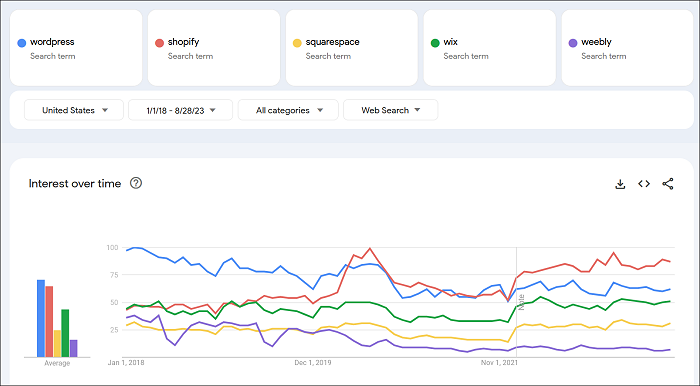
WordPress is the blue line and you can clearly see that interest is lower at the end than at the beginning.
Shopify is the red line and it has grown to overtake interest in WordPress.
Wix is green and currently higher than Squarespace in yellow and Weebly in purple.
What Does This Tell Us?
WordPress currently powers 43% of all the top sites already.
So, maybe there is no real need for folks to do a search with WordPress as a term in their query like there was when it only powered a fraction of that many sites.
In other words, I don’t think Google search trends are indicative of how popular WordPress is.
I don’t know why any newbie bloggers would do a search for it these days. Instead, they are looking for gurus to teach them how to make money blogging.
Impact of Mommy Bloggers
But, I do think the rise in interest in WordPress around 2014 does help us make sense of what we’re seeing with Shopify and other all-in-one platforms.
WordPress hit its top interest when the mommy blogger craze was coming into its straight up trajectory.
Pinterest became a household word around 2011. And it took a couple of years for bloggers to capitalize on that popularity to the point that they could show other bloggers how much they made in ad revenue and start selling those courses.
Interest in WordPress went through the roof.
And so did searches with the word WordPress in them.
2014 is about the time that BlogAid started to really take off too because of all those searches that had the word WordPress in them.
Decline of Blogging for Ads
Pinterest eventually betrayed the very contributors that helped it become a household word.
And without that driving force of traffic, many blog-for-ad revenue site owners failed.
Plus, the internet was becoming completely saturated with foodie and DIY type sites that all looked and acted the same, and it became super hard to compete for traffic, especially in search.
The Rise of Products and Courses
The bloggers who have survived started turning toward selling their expertise in courses and/or capitalizing on the huge audience they had built by offering products or affiliating the products of others.
And I believe the search graph from 2018 to today reflects that change.
These folks already have a WordPress blog.
But it is there mainly to support their courses and products revenue.
And Shopify has become the platform of choice.
It includes a blog, but more importantly, you can easily integrate it with your current WordPress site too.
My New Sites are Not About Blogging
I started the AI Discover Hub site with courses and products in mind.
The blog part of it is an afterthought.
My new visitor traffic comes from video platforms.
I make a blog post from that video transcript and embed the YouTube version into the post just to get a bit more SEO from Google.
But my existing BlogAid list, and the relationships I’ve built through that business have been the seed for new traffic. That got me started from a non-zero place.
But the point I’m making is that AIDH was started to be primarily a course site.
The AI Images for Profit course started selling even before I finished it.
And I’ve got at least one more course to add, if not two.
In fact, I already have my first client for one of the new things I’m adding and I haven’t even built it yet.
Which Platform is Best?
Before I created the AI Images for Profit site, I looked super hard at other all-in-one course platforms like Kajabi.
Because I’m a site tech, and because I already have the plugins needed to run a course, I chose to stick with WordPress.
The other reason I chose that is because the other platform’s SEO is so poor. That’s because most of the folks who use them don’t blog or count on SEO for traffic. They buy ads or run vlogs from YouTube only.
I vlog, and I get good SEO from that. But I want a bit of SEO from my site too.
I have another business site that I hope to start next year and I will be integrating a store with it. And since the entire focus with be vlogging and a course, I may or may not use WordPress. I have no intention of blogging on it.
So, the platform that works best for you depends on what you need to do. That’s why I insist on doing a consult first, find the money, find more money in it, make the plan, and then choose the best platform for that plan.
Monetization Tips
Is It Time For a Change?
For going on 3 years now I’ve been advising my blogger clients to get into video and consider courses and products.
It’s been a 50-50 split of those who have made that change and those who haven’t.
Here’s why.
Keep Doing What Works
About half of my clients are super well established with their blogs.
They got in on the Pinterest craze early and have been making anywhere from $5k-$20k/mo from just ad revenue on their site all these years – and still are making that much even with the decline of Pinterest overall.
Many of those bloggers are also nearing retirement age (from late 50s through mid 60s).
They have zero desire to learn all the new fangled trends and ways of doing things.
In fact, they really don’t even have to create new blog posts much anymore.
They spend a little time a week updating posts and social media.
And they’ll let it stay this way until they retire.
I don’t blame them. I would do exactly the same in that situation.
Capitalize on Audience
You work hard to build an audience. Are you making the most of it?
One of my clients jumped into video the minute I suggested that we should go there.
She built up an amazing following of loyal subscribers.
And then she capitalized on that by writing a book that she knew they would like.
Even her publisher was amazed by the number of books they sold day one.
In fact, they sold out of all that they had printed already.
A year later, that book is still selling like crazy.
What kind of money are you sitting on just because you won’t consider sharing your expertise in a product or a course?
Or, is it that you have not built a loyal tribe of followers yet? That’s your key to making the most money no matter how you gain revenue.
Time To Try New Things
But, the other half of my clients are not so well established.
They are struggling to get seen in highly saturated niches.
So, they are more willing to try new things and learn about anything that will give them an edge over the competition.
They are doing video.
They now have shops and/or courses.
They see ad revenue as a side hustle, not their main money maker.
In fact, some are considering dropping the ads altogether.
And some are looking at running only sponsored ads that they manage themselves.
Their sites have FAR higher UX (User Experience) and they are building a tribe of repeat visitors that want everything they’ve got.
Incorporate AI
Here’s a fact.
AI will make its way into everything that exists online.
AI is already making folks more productive with content and social media creation.
Just ask the folks in the AI Success Club that is run by my friend Denise Wakeman.
Just ask the folks in my AI Images for Profit course.
And soon I’ll have folks for you to ask in my upcoming AI courses and other AI business endeavors.
I’m literally bursting at the seams with AI business ideas.
Get a consult and let me help you find ways you can use AI to branch out into a related product or service.
Think about this.
What if someone had told you about blogging at least 2 years prior to you finally getting interested in it?
How much more money could you have made by getting in early?
That’s the same opportunity you have right now with AI.
This is the time fortunes will be made.
Are you in?
